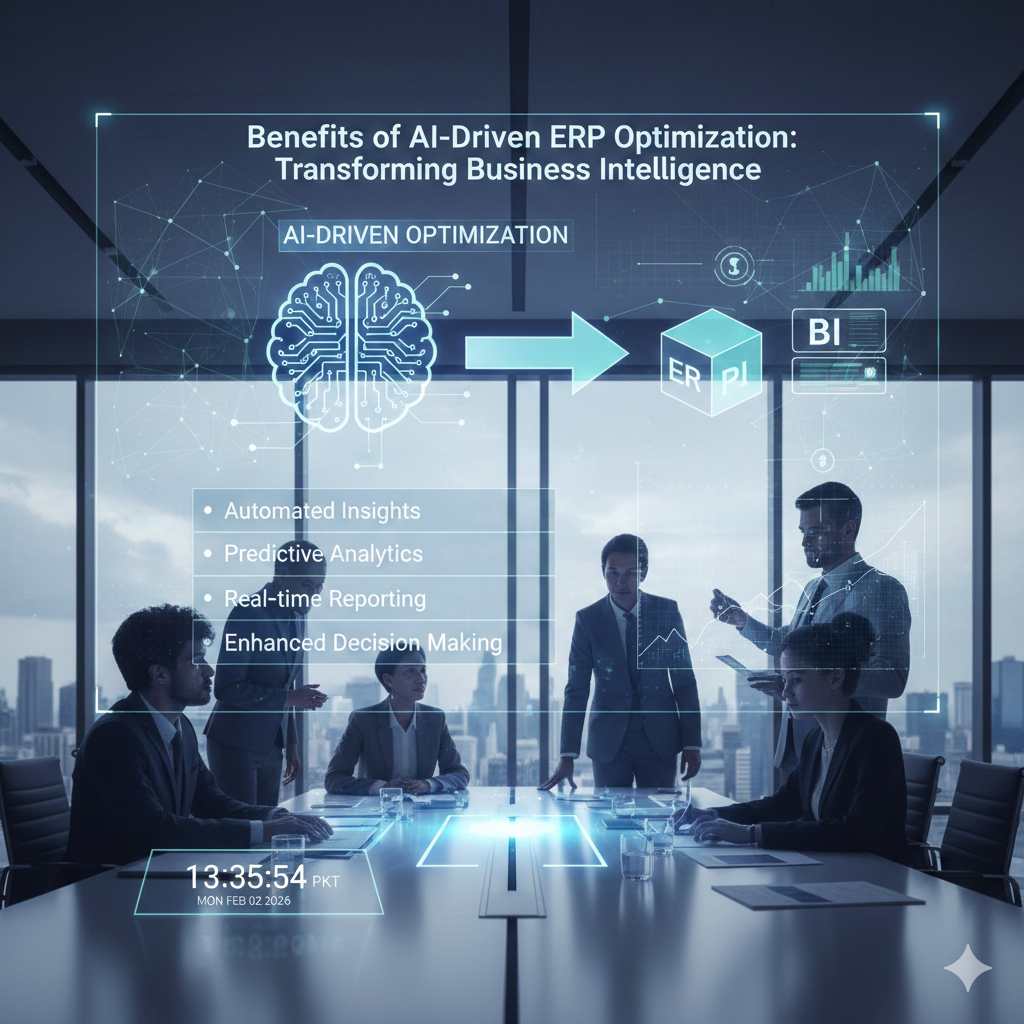
Companies have been using enterprise resource planning systems for decades, yet AI is transforming them in significant ways. Artificial intelligence-powered ERP optimization improves upon legacy ERP processes with predictive analysis, smart automation, and adaptive learning. Such advanced systems do not merely record what happened yesterday but also forecast what will be needed tomorrow, prescribe the most appropriate course of action and also constantly improve performance. Companies that implement AI-based ERP solutions obtain more operational intelligence, faster response time, and a superior sense of business dynamics.
- Enhanced Forecasting and Demand Prediction
Artificial intelligence produces amazingly accurate projections for personnel, inventory, and resource allocation by analyzing past trends, market trends, seasonal variations, and external factors. Machine learning algorithms identify subtle patterns that humans might overlook and modify predictions as circumstances change, in contrast to classic statistical methods that rely on strict formulas. By lowering stockouts and extra holding expenses, this capacity assists businesses in maintaining ideal inventory levels. Production schedules match actual demand, purchasing teams acquire goods precisely when needed, and data-driven estimates improve the accuracy of financial planning.
- Intelligent Process Automation and Efficiency
AI finds repetitive operations in ERP workflows and intelligently automates them, handling exceptions in addition to variations in addition to basic rule-based automation. Accounts are reconciled. Invoices are processed automatically. Purchase orders are matched with receipts.
Exceptions can be highlighted for follow-up. Less time is spent entering data and more time is available for value-added problem-solving and analysis. Manual errors are eliminated and output is increased (often from days to hours) with workflow automation. Productivity is boosted without additional personnel and overhead by utilizing what you already have.
- Proactive Issue Detection and Prevention
ERP data streams are regularly monitored by machine learning algorithms, which spot odd patterns that indicate possible issues before they become expensive failures. The system may identify equipment performance degradation that indicates impending breakdowns, customer payment patterns that indicate financial difficulties, delayed supplier deliveries, and quality problems that arise in production. Proactive interventions, such as contacting other suppliers, modifying production schedules, resolving customer issues, or arranging preventive maintenance, are made possible by early alerts. By converting reactive problem-solving into strategic risk management, this predictive technique safeguards income and client pleasure.
- Data-Driven Strategic Insights and Analytics
Large ERP datasets are converted by artificial intelligence into strategic intelligence that can be used to drive executive decision-making with previously unheard-of clarity. Profit-driven products, underperforming business sectors, operational inefficiencies, and growth prospects concealed within everyday transactions are all found using advanced analytics. Managers can ask questions in a conversational manner and get thorough responses right away thanks to natural language processing. Before allocating resources, leaders can assess strategic options with the aid of predictive models that simulate different situations. Instead of concentrating insights within specialist analyst teams, this analytical capacity democratizes data access as well as enables informed decisions across organizational hierarchies.
Conclusion
When lifecycle governance, automation, and intelligence coexist harmoniously, AI-driven ERP optimization reaches its full potential. Opkey is unique in this regard. Opkey’s ERP Lifecycle Optimization Platform expedites adoption, and guarantees operational stability, as well as permits ongoing improvement with low risk, all while safeguarding and extending ERP investments. Organizations can minimize downtime, manage change, and quickly adjust to changing business requirements by utilizing AI-powered configuration management, and intelligent test automation, along with virtual agents coordinated by Argus AI. Businesses use Opkey to continuously optimize ERP systems for performance, robustness, and long-term business effect rather than just maintaining them.