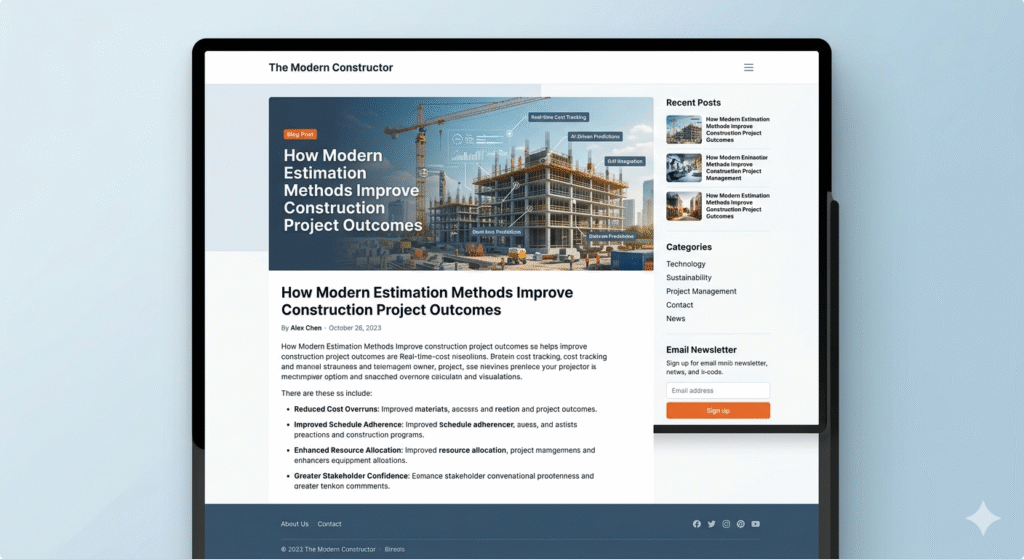
The production industry has developed hastily over the past decade, driven by technological improvements, increasing mission complexity, and rising expectations for performance and sustainability. Today, successful production initiatives depend heavily on accurate planning and specific fee estimation. Without proper economic forecasting, even nicely designed initiatives can experience delays, budget overruns, and operational challenges.
Modern construction groups rely on expert Construction Estimating Services to develop specialized cost forecasts before a project begins. These offerings examine assignment specs, substances, labor requirements, and market conditions to generate reliable financial projections. By making accurate estimates, production firms can reduce uncertainty and ensure that projects start with a realistic financial plan.
Accurate estimation is not the simplest control for undertaking costs, but it also improves typical control for undertakings. When stakeholders truly understand the predicted charges and aid requirements, they can make better decisions regarding layout, procurement, and scheduling. This proactive technique facilitates lessening waste, avoiding unnecessary delays, and keeping financial balance for the duration of the venture lifecycle.
Strategic Planning and Budget Control
Strategic planning is one of the most critical factors of a successful production estimation. It involves studying venture information, predicting ability-demanding situations, and preparing sensible budgets for manual construction projects.
Modern estimation techniques recall numerous price elements, which include cloth costs, hard work productivity, device usage, and transportation costs. By comparing these factors early in the planning phase, task managers can create budgets that replicate actual construction situations.
For instance, if a commercial venture calls for structural steel and the average market charge is about $900 per ton, planners can estimate the approximate price primarily based on the desired amount. If the mission requires a hundred and twenty lots of metallic, the projected fabric cost would be around $108,000 before additional installation and logistics charges are added.
Such projections permit mission teams to discover opportunity substances or construction methods if fees exceed the price range. Strategic planning also guarantees that contingency price ranges are protected to handle unexpected situations, which include delivery chain disruptions or climate delays.
Budget control is maintained throughout the task lifecycle. Project managers track prices frequently and evaluate actual spending against the predicted finances. If discrepancies arise, corrective measures can be taken early to save you from economic issues later in the assignment.
Digital Design Integration for Better Accuracy
Modern production estimation has appreciably stepped forward with the aid of digital design technology that beautifies making plans’ accuracy. Digital tools allow architects and engineers to create particular building models that provide precise measurements and specifications.
One of the most critical technologies utilized in construction planning is CAD drafting services, which produces unique technical drawings for construction projects. These drawings include structural layouts, electrical systems, plumbing routes, and architectural info that guides the construction system, while collaboration with Construction Estimating Companies ensures that these detailed designs are accurately translated into precise cost planning and resource allocation.
Digital drawings permit undertaking teams to calculate cloth portions with tons more precision than conventional guidance techniques. For example, by way of analyzing a virtual floor plan, planners can determine the precise number of bricks, tiles, or beams required for the project.
Another advantage of virtual design integration is advanced collaboration among mission teams. Architects, engineers, and contractors can review virtual fashions simultaneously and pick out layout conflicts before construction starts. This prevents expensive changes at some stage in later stages of the venture.
Digital tools also help keep correct documentation. Any design updates or revisions can be recorded and shared right away with all team participants. This guarantees that everybody involved in the project works with the most modern-day facts, lowering mistakes and enhancing performance.
Data-Driven Decision Making in Construction
Data analytics has grown to become an essential element of modern production estimation. By studying historical undertaking records and current marketplace traits, construction companies can enhance the accuracy of their value forecasts and undertaking planning techniques.
Construction control software permits task teams to track hard work productivity, device utilization, and material intake in real time. This data provides valuable insights that help managers optimize useful resource allocation and manage finances.
For instance, if preceding tasks suggest that installing floors in business construction typically requires zero to five exertion hours per square foot, task planners can estimate the hard work requirements accurately, as they should be for future projects. Such insights improve scheduling efficiency and decrease sudden delays.
Data-driven selection-making also enables production organizations to examine dealer performance and cloth charge tendencies. By reading market statistics, groups should buy materials at the most favorable times and negotiate higher contracts with suppliers.
Furthermore, predictive analytics allows assignment teams to perceive capacity risks earlier than they arise. If historical statistics show that certain forms of projects often enjoy delays due to weather situations or supply shortages, managers can regulate schedules and budgets accordingly
Risk Reduction and Improved Project Performance
Construction initiatives often contain numerous dangers that could affect both budgets and timelines. Modern estimation techniques help lessen those dangers by identifying ability-demanding situations early and preparing solutions in advance.
One effective risk control strategy is the inclusion of contingency finances within challenge budgets. A contingency allocation of around five to 10 percent lets venture groups deal with unexpected charges without affecting overall monetary balance.
Another vital factor of danger discount is procurement planning. By reading price estimates and market traits, venture managers can stabilize substances and devices at aggressive fees before production starts.
Accurate estimation also improves task scheduling. When task teams understand the precise portions of substances and hard work required, they can create practical timelines that reduce the likelihood of delays.
Additionally, current estimation methods assist in enhancing sustainability in construction initiatives. By correctly calculating fabric requirements, businesses can reduce waste and reduce environmental impact. Efficient aid-making plans help both financial savings and sustainable construction practices.
The Value of Professional Expertise in Estimation
Despite the growing use of virtual equipment and automation in production planning, human understanding remains important for accurate estimation. Technology presents treasured information and calculations; however, experienced specialists interpret these facts and apply sensible expertise to actual global, construction-demanding situations.
Professional construction estimators play an important role in comparing challenge necessities, reviewing layout files, and preparing unique price forecasts. Their information ensures that undertaking budgets reflect practical production situations in preference to only theoretical calculations.
These professionals additionally contribute to the bidding procedure, wherein construction groups compete for new contracts. Accurate estimates allow contractors to put together competitive bids while preserving profitability.
Estimators assist with tasks even after construction begins. By reviewing price reports and economic information, they help task managers screen charges and make certain that tasks continue to be aligned with the original budget.
The collaboration between professionals and advanced generations creates an effective framework for cutting-edge construction estimation. By incorporating a Construction Estimating Service, organizations can further enhance accuracy and financial planning. Together, they make certain that initiatives are financially possible, efficiently managed, and completed.
Final Thoughts
Modern estimation strategies have converted the development enterprise by improving planning accuracy, lowering financial risks, and enhancing venture outcomes. Through the use of superior technology, virtual design equipment, and fact-driven insights, production companies can create specified fee forecasts and control sources more efficiently.
Accurate estimation allows mission groups to control budgets, optimize scheduling, and improve collaboration amongst stakeholders. These advantages not only boost challenge efficiency but also assist long-term commercial enterprise growth and client satisfaction.
As construction initiatives continue to emerge as more complex, the importance of dependable estimation will only grow. Companies that spend money on current estimation strategies and professional expertise could be better organized to handle enterprise-demanding situations and deliver successful production initiatives in today’s competitive market.
FAQ’s
1. What are modern-day construction estimation strategies?
Modern estimation methods use digital equipment, statistical evaluation, and expert knowledge to calculate challenge fees as they should be before construction starts.
2. Why is accurate estimation crucial in construction?
Accurate estimation allows for manipulating task budgets, reducing financial dangers, and ensuring that tasks are finished efficiently.
3. How does digital equipment improve estimation accuracy?
Digital gear creates exact undertaking fashions and automates calculations, permitting teams to estimate substances, hard work, and system desires more exactly.
4. What factors have an impact on production fee estimates?
Material expenses, labor availability, device prices, task area, and market conditions all influence production fee estimates.
5. How can construction organizations enhance challenge effects through estimation?
Companies can improve outcomes by using superior estimation software, studying ancient venture statistics, and working with experienced estimation specialists.