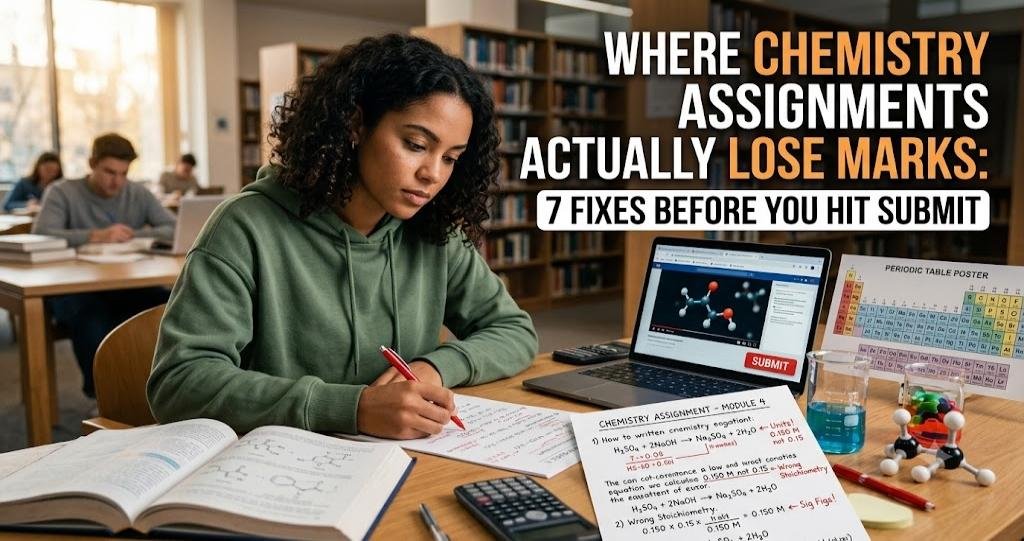
Chemistry is one of the most difficult courses at college or university, as it requires scientific theory, mathematical calculations, and laboratory work. Also, making a chemistry assignment is a challenging task. According to Ofqual (2025), 59,075 chemistry A-level results were issued in England, with 56.0% awarded to female students and 44.0% to male students. The need for knowledge and skills in chemistry goes beyond education, with the chemical sciences contributing a record £60 billion to the UK economy in 2023 (Royal Society of Chemistry, 2026). The challenge is not always understanding the concepts.
Students spend hours on revision and still lose marks due to misunderstandings of command words, algebraic errors, incorrect significant figures, missing state symbols, and poor lab report conclusions. These small but avoidable mistakes can reduce an otherwise strong piece of work. If you have been searching for chemistry assignment help, chemistry coursework help, or chemistry homework help, knowing where marks are commonly lost is the best place to start.
This guide outlines seven practical fixes you can apply before submitting your assignment to improve its accuracy, presentation, and overall quality.
Why Do Students Lose Marks in Chemistry Assignments?
Chemistry assignments aim to enhance your knowledge of scientific principles and concepts, analytical thinking, and problem-solving in the context of chemical reactions, calculations, laboratory experiments, and data interpretation. They also evaluate your scientific ideas and your ability to communicate them accurately, with the appropriate structure, terminology and evidence. However, small yet avoidable mistakes in the writing and presentation of the work can cause even well-prepared students to lose marks.
Here are seven practical fixes that can help you avoid common mistakes and improve your chemistry assignment before submission.
Fix 1 — Answer the question that was actually asked (command words)
A common reason students lose marks is not that they lack an understanding of chemistry, but because they answer a question other than the one asked by the examiner. This mistake is frequently seen in chemistry homework and coursework, where students overlook the specific instructions in the question. Understanding these instructions is a fundamental study skill and can significantly improve the accuracy and quality of your answers.
Describe what you see or hear, and explain the scientific reasons behind what you see or hear. Similarly, identify asks you to name a substance, process, or compound, whereas calculate expects you to show every step of your working before presenting the final answer. Even if you are correct in your chemistry knowledge, you can lose marks for failing to recognise these differences.
| Command Word | Examiner Wants |
| Describe | State what you observe. |
| Explain | Give scientific reasons for what happens. |
| Calculate | Show each step of the calculation and include the correct units. |
| Identify | Correctly name the substance, compound, or process. |
Underline the command word in each of the questions before writing. This quick habit stops you from answering the question you assume is being asked rather than the one actually in front of you. Knowing the meaning of command words is a crucial study skill, whether you are working on coursework, homework, or a full written assignment. Across organic, physical, and analytical chemistry alike, assessments test both your subject knowledge and your ability to respond correctly to the question you have been set.
Fix 2 — Show your working: the method carries the marks
In chemistry, the final answer is not the only thing that earns marks. The examiner assesses the process; therefore, it is important to show all calculation steps. Even if the final answer is wrong, a correct method can still earn method marks despite a few numerical slips.
Below is a worked stoichiometry example showing the correct method, from writing the balanced equation to calculating the final answer. Follow this structure whenever you solve chemistry calculations to maximise your marks.

This is especially crucial in learning how to solve a stoichiometry problem, as every step of work is a representation of a scientific thought. For chemistry calculations assignment help, chemistry problem-solving assistance, chemical equations assignment help, or physical chemistry assignment help, always show your working in logical order. Dimensional analysis is also important because it shows that the units cancel out properly, minimising chances of calculation errors. This way, you will build confidence before exams and practicals as well.
Fix 3 — Units, significant figures and decimal places.
The easiest marks to lose in chemistry are due to minor presentation rather than a lack of scientific understanding. In chemistry, significant figures matter more than decimal places, and missing units, incorrect rounding, and misread significant figures all can cost you marks. A common guideline is to match your final answer to the least precise measurement used in the calculation. This indicates accuracy and is in keeping with scientific practice. When doing chemistry homework or preparing chemistry coursework, always check your units and significant figures. In chemistry calculations, analytical work, and lab reports alike, it is also crucial to report experimental results accurately.


Note: There is a difference between the number of significant figures and the number of decimal places! They are not the same.
Quick Tip
When completing your assignment, take one minute to ensure that all calculated values are in the correct units and have been rounded to the appropriate number of significant figures. Those last checks may protect easy marks that are easily overlooked.
Fix 4 — Balance the Equation and Get the State Symbols Right
Balancing equations may look like a simple step, but it is one of the easiest places to lose marks. If mass is not conserved, the given equation is unbalanced; if one or more of the state symbols are missing or incorrect, the answer may be incomplete even if the equation is balanced. These small errors are frequently found in organic and inorganic chemistry work, where reactions must be shown in the appropriate chemical notation. They also matter in any calculation task because balanced equations are used to determine the quantities of reactants and products.
Always remember to make sure that the number of atoms of each element is the same on both sides of the equation and that each substance is given a state symbol (s) for solid, (l) for liquid, (g) for gas, and (aq) for aqueous solution before submitting your work. It is sometimes possible to identify errors in your work that you may not have noticed by doing a second review or by comparing it with a model answer.
Worked Example
- Unbalanced Equation: H₂(g) + O₂(g) → H₂O(l)
- Balanced Equation: 2H₂(g) + O₂(g) → 2H₂O(l)
State Symbols at a Glance
State Symbols and Their Meanings
(s) – Solid
(l) – Liquid
(g) – Gas
(aq) – Dissolved in water (aqueous solution)
Fix 5 — Write A Lab-Report Conclusion That Answers the Aim
Students often spend hours collecting and analysing results, yet lose marks because the conclusion does not address the aim of the experiment. The conclusion should not just summarise the results; it should interpret their meaning and explain whether they support the hypothesis.
A common problem you can solve with chemistry lab report help is a conclusion that is a little more than an observation. Whether you are writing up a practical, a research task, or a biochemistry report, a clear conclusion structure will enhance the quality of your work.
Weak Conclusion
“The experiment was successful, and the expected result was obtained.”
Strong Conclusion
“The titration determined the concentration of hydrochloric acid to be 0.102 mol dm⁻³, which was close to the expected value of 0.100 mol dm⁻³. This supports the aim of accurately determining the acid concentration. Minor differences may have resulted from reading the burette incorrectly, while repeating the experiment and using a white tile to identify the end point more accurately would improve reliability.”
A Simple 3-Step Template
- State the result.
- Link it back to the aim or hypothesis.
- Identify sources of error and suggest improvements.
A simple three-step approach works well. First, state the principal result of the experiment. Second, provide scientific evidence to support or refute the aim or hypothesis. Finally, consider one or two sources of error and propose realistic modifications that may lead to more reliable results from the investigation. This will demonstrate critical thinking and enhance the quality of your report. One further habit worth building: reread the at the top of your brief before writing, and answer it directly in your first sentence; markers look for that explicit link immediately.
Fix 6 — Reference properly (ACS / Harvard)
Even if your chemistry content is correct, it is easy to lose marks by not referencing correctly. Before starting, make sure your department requires Harvard or ACS referencing; each has different citation rules. You can cite the author’s name and year in the text, in Harvard style and in ACS style, with numbered citations matching the reference list.

When writing a chemistry research assignment, students often lose marks through mixing referencing styles or omitting key publication details. Likewise, if you are preparing chemistry coursework, every reference cited in the body of the text should also appear in the references list. Do not use lecture slides as the main reference unless instructed to by the lecturer.
Rather, reference a book, journal article, or trusted scientific online source to support your work. The submission’s professionalism will also improve if you follow the correct chemistry assignment structure and format. When you are seeking chemistry assignment writing help, always leave some time to check every citation before you submit.
Fix 7 — Do A Rubric Self-Check Before You Submit.
Students often complete their assignment and hand it in without comparing it to the marking rubric. But by taking a few extra minutes to check your work against the assessment criteria, you can avoid losing marks. Read each line of the rubric and tick it off as you confirm it has been addressed. This will be useful when doing chemistry case study assignments, which involve multiple assessment criteria.

Students who are preparing their chemistry homework or searching for chemistry assignment solutions should also go over all calculations, verify units, and read the homework aloud to catch any odd wording or missing information. If you do seek online chemistry assignment help, remember that proofreading or a comparison with a model answer will reveal mistakes you may not notice in your own work. Lastly, check that your references, calculations, figures, and tables are all consistent with the marking criteria before submitting.
Conclusion
Achieving higher marks in chemistry is not always about learning more content; often it is about avoiding a few small, easily preventable mistakes. These seven checks can make a difference, from interpreting command words and showing your working to checking significant figures, writing effective lab report conclusions, and comparing your work against the marking criteria. Use this checklist with each assignment you submit.
If you would like additional support, compliant chemistry assignment help is available from Fast Assignment Help in the form of worked model answers to learn from, along with editing, proofreading, and guidance from academic professionals, to help you strengthen your understanding and refine your assignment before submission, without compromising your academic integrity.
FAQs About Chemistry Assignment Help
What is the best chemistry assignment help service?
The best chemistry assignment help service is one that supports learning rather than completing work on your behalf. Look for providers that offer model answers, editing, proofreading, and academic guidance to help you understand complex chemistry concepts while maintaining academic integrity.
Can I pay someone to write my chemistry assignment for me?
Universities and colleges expect students to submit their own work. Instead of paying someone to write your assignment, use chemistry assignment help services that provide model answers, proofreading, or academic coaching to improve your understanding and help you produce your own high-quality work.
Is there a free chemistry solver online?
Yes, several websites provide free tools for solving chemistry equations, balancing reactions, and performing calculations. However, always verify the answers and understand the workings behind them. Free solvers are useful for chemistry study help, but they should complement your learning rather than replace it.
How can I get an A in Chemistry A-Level?
Achieving an A or A* requires consistent revision, practising past papers, mastering calculations, understanding command words, and reviewing examiner feedback. Before submitting coursework or practical reports, use a checklist to verify calculations, significant figures, referencing, and presentation. When needed, chemistry homework help or academic guidance can also help strengthen your understanding of challenging topics.