In school, most children can easily form letters by hand. At home, however, they often freeze or struggle to express consistent ideas when faced with a blank page. As long-term communication skills are formed by writing habits, isolated lessons will not solve this problem. Fortunately, combining daily home practice with structured online writing tutoring helps children build both the habit and the skill in parallel.
Here we discuss how to implement short practice sessions, choose age-appropriate writing activities, and avoid common motivational traps. Therefore, parents must learn how to teach a child to write through gentle guidance rather than strict pressure.
Why Consistent Practice Beats Natural Talent
Unlike adults, children cannot communicate clearly from birth. But with practice, they expand their vocabulary every day, actively memorizing words. As their vocabulary expands, passive words become active and are used more frequently in communication. Frequent use of new words improves sentence structure over time. Children are less anxious about writing when they see their thoughts taking shape.
Regular routines like the ones described below are essential for parents who want to know how to improve writing skills without causing daily stress.
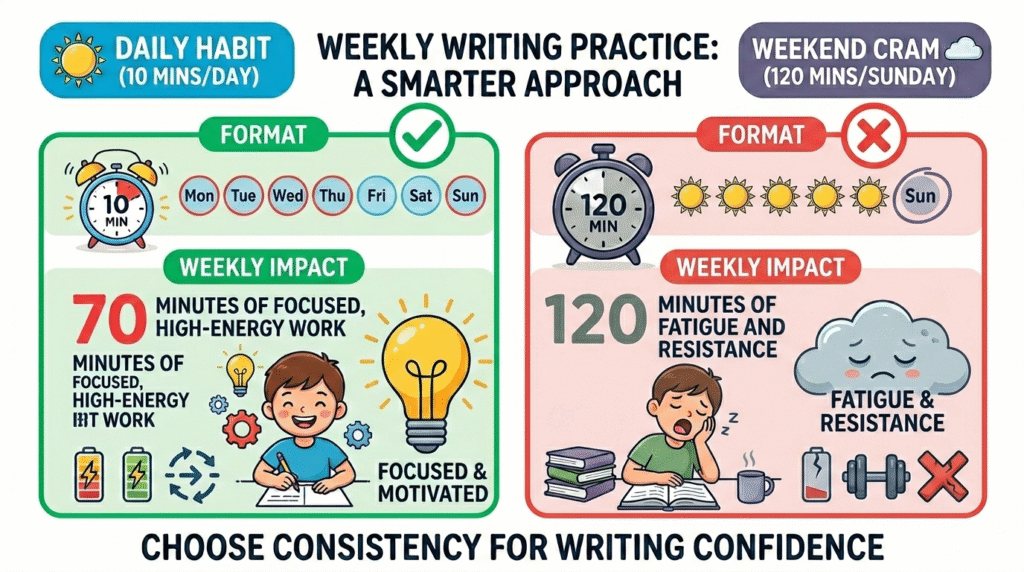
The 10-Minute Daily Writing Rule
Short sessions are best because they prevent cognitive fatigue. For brief periods, young minds can maintain sharp focus. A task lasting 10 minutes or less is unlikely to provoke resistance from children. To them, the effort has a clear endpoint. So, set a timer for your physical activity and stop when it rings.
What Counts as Practice
By limiting your child’s writing to school essays, you will limit their growth. Having a broader perspective allows them to create a wider variety of texts and provides regular practice. For example, try writing:
- Lists of groceries. Write down the household food needs with your child.
- Logs of chores. List the tasks they have completed each day.
- A family note. Place a short thank-you note on the kitchen counter
- Story starters. Ask them to write the next sentence after you write the first.
Age-Appropriate Writing Activities That Stick
Since children develop cognitive skills gradually, parents should select tasks strictly according to their current age. Such precise adaptation protects the child from overload, ensuring the exercises always remain interesting. As a result, the child begins to perceive learning positively, allowing parents to more easily introduce more complex tasks at each subsequent stage of development.
Ages 5–8: Activities for Early Learners
For young children to maintain interest in handwriting, they require highly visual and cooperative prompts.
- A visual representation provides a child with an immediate reference, making it easier for them to write descriptive words.
- Leaving a sentence unfinished creates a structured gap, which prompts the child to complete the thought using their own vocabulary.
- Because speaking is easier than writing for this age group, a child can dictate a story while the parent writes it down, which teaches the child that spoken words turn into text.
These specific writing activities for kids reduce frustration and steadily build early motor skills and spelling confidence. Parents can also use simple writing prompts for kids to kickstart the process without long arguments.
Ages 9–12: Activities for Independent Writers
As children at this age have a larger vocabulary, they need more complex tasks to develop critical thinking and paragraph structure.
- A special notebook encourages daily creative activity that helps children track storylines over several days.
- When a child needs to defend a particular point of view, they learn to argue for their position.
- Writing letters to relatives allows kids to choose a certain tone for each relative, knowing them personally, and some inside jokes.
Children often develop a genuine interest in storytelling at this stage, and with creative writing tutor support, they can master their skills more quickly. This targeted support ensures that their growing interest turns into permanent writing skills for kids. Introducing regular exercises in creative writing for kids will further reinforce these advanced habits.
How to Make Writing Feel Like a Choice, Not a Chore
Children resist tasks that are imposed on them, so you, as a parent, should not focus on strict instructions. When you force a child to write about difficult topics, there is psychological pressure on your part and resistance on the child’s part. Offer them alternatives; when the choices are greater, the child will feel heard and that they have the right to choose.
Let Kids Choose Their Topics
Let your child choose topics that interest them. It is important to listen to the child’s preferences, and they will be happy. Ask your child to write about their favorite video games, cartoon characters, or fairy-tale heroes. Writing becomes more interesting and reveals new sides of a child’s thoughts about what they do and what they love. At the same time, the child remains autonomous and engages in writing.
The “Red Pen” Trap
You shouldn’t correct every mistake your child makes. Excessive and constant criticism kills the desire to share ideas and develop thought. A child may think that he or she is incapable of writing, and this will discourage the desire to do anything at all. As a result, their creativity stagnates. Prior to refining mechanics, a child must feel safe making mistakes, which can help prevent this outcome.
Common Mistakes Parents Make (And How to Avoid Them)
As a parent, if you want to see interest, don’t expect quick results and perfect work the first time. Acknowledge that your child is making mistakes and adjust your approach before your child loses motivation.
- Unrealistic goals: Don’t expect your child to start writing long paragraphs right away. Limit your first few sessions to three sentences to avoid fatigue.
- Too many edits at once: Constant mistakes make your child anxious and discourage them from continuing. To prevent your child from avoiding writing altogether, point out 1–2 mistakes at a time, rather than all the mistakes in the text at once. Keep the learning gradual.
- Prioritizing grammar over ideas: Value the essence of the text, not correctly placed commas or colons. Spelling can be made up later; the main thing is not to disrupt the flow of thoughts and ideas.
- Reluctance to write after omissions: Suspending the routine works, but stopping completely breaks the habit, so you should just start the next morning without feeling guilty.
Conclusion
Since strong writing skills develop gradually, regular daily practice becomes much more important than perfect grammar. Such regularity is only possible when parents create an atmosphere of calm instead of pressure. This calm allows the child to feel safe, so he stops being afraid of every missed comma. Ultimately, it is parental presence that builds a stable confidence that will help your child write dozens of future works with ease.